
Event Conference
Employment in the Circular Economy: Leveraging Circularity to Create Decent Work
04 Dec 2025
14:00 – 15:30
Venue: ILO Building | Room VI and Online | Webex
Organization: International Labour Organization, World Bank Group Geneva Office, Circle Economy, Partnership for Action on Green Economy, Geneva Environment Network
The hybrid event launched the Global Circular Employment Baseline Report - the culmination of the ILO-Circle Economy-World Bank’s “Jobs in the Circular Economy” initiative to measure, model and monitor jobs in the circular economy.

About this Event
This event marked the launch of a seminal report, the Circular Jobs Global Baseline Report, co-authored by the ILO, Circle Economy Foundation, and the World Bank Group as part of the Jobs in the Circular Economy initiative. The report is the culmination of three years of collaboration between the three agencies aimed at putting data and practical tools in the hands of policymakers and decision-makers to accelerate a just and job-rich transition to the circular economy.
The report presents the first global baseline of circular employment, providing estimates of the scale, structure, and characteristics of employment across circular economy activities. Covering 177 countries, it estimates circular economy employment in both the formal and informal economy.
Leading experts joining the panel of the event presented the results from the Global Circular Employment Baseline Report, with a particular focus on decent jobs, bolstering sustainable enterprises, and improving conditions of work. Presentations provided an overview of data and evidence from the new report, and invite perspectives from policymakers, employers, workers, startups, civil society and international organizations. The event highlighted the need for a stronger evidence base to support the transition toward a circular economy.
Speakers
By order of intervention.
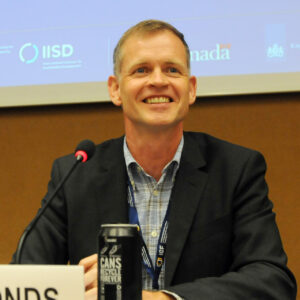
Casper EDMONDS
Head of Unit, Extractives, Energy and Manufacturing in the Sectoral Policies Department, International Labour Organization

Esther GOODWIN-BROWN
Lead, Circular Jobs Initiative, Circle Economy

Diana JUNQUERA CURIEL
Director, Energy Industry and Just Transition, IndustriALL Global Union

Robert MARINKOVIC
Adviser, Climate Change, International Organisation of Employers
Joaquim Bento DE SOUZA FERREIRA FILHO
Senior Professor, Department of Economics of Escola Superior de Agricultura “Luiz de Queiroz” (ESALQ), University of São Paulo, Brazil

Kidus ASFAW
Founder and CEO, Kubik
Namita DATTA
Global Head, Gender & Economic Inclusion Thought Leadership, International Finance Corporation
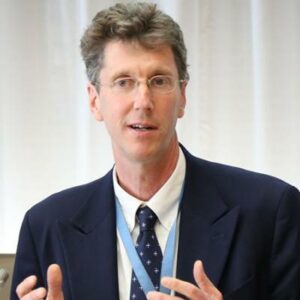
Steven STONE
Chair, UN Partnership for Action on Green Economy | Deputy Director, Industry and Economy Division, UN Environment Programme
Highlights
Video
Live from ILO
Summary
Casper Edmonds | Head of Unit, Extractives, Energy, and Manufacturing in the Sectoral Policies Department, International Labour Organization
- The employment baseline report, for the first time, provides a comprehensive picture of how many people work in the circular economy by mapping circular economy activities onto the UN International Standard Industrial Classification of all Economic Activities (ISIC). Showcasing that it is possible to measure global employment in the circular economy.
- It further provides a tool that enables monitoring of circular jobs and informs policy and decision makers on how to generate opportunities for sustainable enterprises and to create jobs in the circular economy.
- The report, while promoting entrepreneurship, sustainable enterprises, innovation, new technologies, and skills, most importantly acknowledges the contribution of millions of workers driving the circular economy today. It also highlights the need for a just transition with millions of people working in the informal sector of the circular economy, in poor and hazardous conditions, without representation.
Esther Goodwin Brown | Circular Jobs Programme Lead, Circle Economy
- As the first global baseline of employment in the circular economy, it covers 177 countries, 8 of 9 broad ISIC sectors, the formal and informal economy, jobs held by women and men, and focuses on measuring direct circular employment.
- The baseline study employs a building block approach, classifying economic sectors as whether they are fully circular or partially circular sectors. Agriculture was excluded from this framework due to the lack of an internationally agreed-upon definition or classification of circular activities in the agricultural sector.
- This first global baseline of employment in the circular economy finds that 5 to 5.8% of the total workforce in the scope of the study are working in the circular economy. This means that at least 121 to 142 million people work in the circular economy today. With 26% being women, and the majority of workers (85.5%) working in fully circular sectors.
- Repair and maintenance accounts for 46% of circular economy employment, the sector driving circular economy employment globally, followed by urban transport (22.2%) and manufacturing (24.6%).
- Low circular employment shares are found in manufacturing, with 7.5% of total sectoral employment found to be circular, and construction, with 3.1%. This suggests there is untapped potential to diversify and scale employment in these key industrial sectors.
- Circular economy employment is present in all regions and income groups, but is unevenly distributed. We find moderate variations in regional shares, with the Americas leading with a 6.4% share of circular employment, followed by Asia and the Pacific (5.8%), Africa (5.6%), Europe and Central Asia (5.4%), and lastly the Arab States (4.9%).
- Informality is a defining feature of the circular economy, with 52% of all circular economy employment being informal (over 74 million). Mostly concentrated in Asia and the Pacific (50 million), Africa (10.3 million), and the Americas (9.7 million). In these contexts, the circular economy can be seen to be more necessity-driven and focused on the generation of livelihoods, rather than driven by industrial policy at the national or regional level.
- Key conclusions of the report highlight that:
- A few sectors dominate global circular employment with untapped potential to scale circularity and decent work in strategic sectors such as manufacturing and construction.
- Opportunities and vulnerabilities differ across income groups, technological integration, and social structures. Labour intensive and necessity driven work is more prevalent in lower-income economies, compared to high-tech, infrastructure-driven circular economy employment in higher income economies.
- Rights-based approaches that are context-specific can support a twin transition towards circularity and formality, and with it decent work.
- Significant data gaps were found, which underestimates the scale and contribution of informal workers, women, secondary occupations, and lower-income countries.
- Key recommendations focus on:
- Aligning circular economy policies with international labour standards and embedding social dialogue.
- Strengthening data systems to avoid unintended policy impacts and enable realistic job modelling.
- Integrating social risks and vulnerabilities considerations to circular economy policy design and social dialogue.
- Inter-ministerial coordination, policy coherence, and active involvement of world-of-work actors.
- Targeted investment, context-specific formalisation strategies and inclusive labour market policies.
Namita Datta | Global Head, Gender & Economic Inclusion Through Leadership, International Finance Corporation
- The initial discussion driving the report asked whether there could be a ‘win-win’ scenario where there is a just and circular transition, where there is a positive contribution to jobs and the environment around the world.
Robert Marinkovic | Adviser, Climate Change, International Organisation of Employers (IOE)
- There are a lot of solutions and good circular practices, but there is an ongoing discussion on defining what can work to ensure a just transition, and what are the feasible solutions for the transition to a formal economy.
- For the private sector, incentivising measures can be supportive to drive investment.
- Currently, there is a premium cost on sustainability due to the additional labour component, thus, measures that smooth out the difference can enable and incentivise action.
- Having more embedded data showing what works across business models can support the implementation of a systematic, holistic approach to develop an ecosystem that integrates sustainability.
- To ensure a just transition, the starting point is to understand who is affected and then develop a transition plan or industrial policies that take this into account.
Diana Junquera | Director, Energy Industry and Just Transition, IndustriALL Global Union
- When it comes to circular jobs, quantity is not enough. If the circular jobs that we see right now continue to grow based on the current labour market model, it will replicate the existing vulnerabilities.
- Different areas should be prioritised.
- Informality, where stronger policies are needed to ensure access to social protection, decent wages, fundamental rights, collective bargaining, occupational health, and safety.
- Addressing the concentration of circular jobs in low-paid segments in the value chains requires investment in skills and technology to allow workers to move up in the value chain, be more productive, and attain higher wages.
- Social dialogue and worker participation, as policies, can only succeed if workers are part of the decision-making process.
- The study brings:
- Concrete figures that can be brought into negotiations, conversations on skills development and social protection frameworks, and the development of circular economy policies and strategies.
- Knowledge on where circular jobs are, what their quality is, and what protections are needed.
Kidus Asfaw | Kubik
- One of the key challenges rising from informal practices includes inconsistent pricing. For instance, an individual waste picker who generally charges higher fees and experiences worse working conditions, and aggregators who charge less.
- Over the past four years, Kubik has been able to engage with over 700 waste pickers in Ethiopia, with the majority of them being women, and through this has quadrupled their income with fair compensation and market-competitive prices.
Joaquim Bento de Souza Ferreira Filho | Senior Professor, Department of Economics of Escola Superior de Agricultura “Luiz de Queiroz” (ESALQ), University of São Paulo, Brazil
- To integrate agriculture, we need to rethink the concept of the circular economy. Most circular economy frameworks focus largely on manufacturing-related activities, ignoring biological cycles. This discussion would be the first step to make it easier to work on agricultural statistics and bring this important sector into the global baseline.
- We must not forget that many agricultural activities are circular by nature and there are adjacent sectors and activities, such as forestry and biofuels.
Steven Stone | Chair, UN Partnership for Action on Green Economy | Deputy Director, Industry and Economy Division, UN Environment Programme
- This is a big milestone. Today, we know where there are circular economy jobs in 177 countries using official statistics. Every country can now have a conversation about what its circular economy looks like and what the required skills. These conversations can now play out with employers, labour unions,
- We now need to consider where we go from this huge accomplishment and how we can improve our understanding of what is happening in the informal economy, that this study shows we still know very little about.
- Going forward:
- We need to integrate the agricultural sector and better understand the role of workers in the informal economy.
- We should determine the upper-bound limit of circularity and how we shift the production possibility frontier and the circularity frontier that is hardwired into the architecture of the economy.
- Explore in depth what can be done with the information and data gathered in this report, and take it to workers, employers and policy-makers, country by country.
Gallery


